Why Understanding Backlink Types Determines Your Ranking Ceiling
The reason most sites lose in SEO competition is not due to a lack of backlinks, but because they fail to understand which types of backlinks actually influence rankings.
By 2026, Google no longer evaluates backlinks as a single ranking factor. Instead, backlinks are analyzed through a classification structure based on:
-
backlink type;
-
placement quality;
-
contextual trust;
-
topical relevance;
-
authority ecosystems.
This simply means that two competing websites may have the same number of backlinks, yet achieve dramatically different rankings depending on the quality and structure of those links.
Understanding backlink types is no longer optional.
It is now a foundational part of modern SEO strategy.
The Modern SEO Reality: Backlinks Are Classified, Not Counted
Search engines today evaluate backlinks using structural interpretation systems powered by:
-
evolving PageRank models;
-
topical authority networks;
-
entity-based indexing systems.
Google no longer asks:
“Does this page have many backlinks?”
Instead, Google asks:
“What types of backlinks support this page, and how reliable and contextually consistent are they?”
This is exactly why learning backlink classifications is essential before building any serious SEO campaign.
Do Follow Backlinks: The Fundamental Ranking Signal Layer
Do follow backlinks remain among the strongest backlink signals in SEO because they transfer authority, commonly referred to as link equity.
However, in modern SEO, do follow links are not automatically powerful.
Google evaluates factors such as:
-
relevance of the linking page;
-
contextual alignment of the content;
-
authority consistency of the domain;
-
semantic relationship between topics.
An irrelevant do follow backlink placed on weak or disconnected content may carry little value.
On the other hand, a contextual do follow backlink from a mid-level but highly relevant website can significantly improve rankings.
In 2026 SEO:
Do follow backlinks are not powerful because they exist.
They are powerful because they exist inside trusted topical ecosystems.
No Follow Backlinks: The Indirect Trust Amplifiers
Although no follow backlinks do not traditionally pass link equity, modern search engines still evaluate them as behavioral trust signals.
They contribute to:
-
natural backlink diversification;
-
brand visibility;
-
sustainable linking behavior;
-
audience engagement patterns.
A no follow backlink on a high-traffic website can still generate valuable engagement and visibility signals that indirectly strengthen SEO performance.
In Modern SEO:
No follow backlinks are not direct ranking factors.
They function as trust anchors within a balanced backlink ecosystem.
Editorial Backlinks: The Ultimate SEO Link Type
Editorial backlinks are links naturally given by other websites because the content being referenced provides genuine value.
These backlinks represent one of the purest forms of SEO trust because they cannot easily be mass-produced without detection.
Google views editorial backlinks as:
-
behavioral trust signals;
-
organic relevance indicators;
-
topical authority proof.
This is one of the primary reasons editorial backlinks are consistently found across high-ranking pages.
Guest Post Backlinks: Controlled Authority Placement
Guest post backlinks are acquired through publishing content on external websites while including contextual links.
In 2026, guest posting remains effective only when the content resembles authentic editorial material rather than obvious SEO manipulation.
Search engines evaluate guest post backlinks through:
-
originality of the content;
-
content depth and usefulness;
-
editorial consistency with the host website;
-
outbound link density;
-
user interaction metrics.
High-quality guest posts blend naturally into the host website’s ecosystem.
Low-quality guest posts are easily identified as artificial SEO tactics.
Niche Edit Backlinks: Utilizing Established Ranking Momentum
Niche edit backlinks involve inserting links into already indexed and established content.
Their strength comes from inheriting:
-
existing indexing trust;
-
established authority signals;
-
search visibility momentum.
Unlike guest posts, niche edits benefit from already trusted environments rather than starting from scratch.
However, relevance remains critical.
If the inserted backlink disrupts the integrity of the content, search engines may completely ignore its value.
Contextual Backlinks: The Real Ranking Multiplier
Contextual backlinks are links naturally placed within the main body of relevant content and surrounded by semantically related text.
These are considered among the strongest backlink structures because they:
-
preserve editorial intent;
-
reinforce topical relevance;
-
align with search intent;
-
strengthen semantic trust signals.
Search engines assign significantly more value to contextual backlinks compared to structural links such as:
-
footer links;
-
sidebar links;
-
author bio links.
In 2026 SEO:
Placement context frequently matters more than raw domain authority.
Profile, Directory, and Social Backlinks: Supporting Signal Sources
Profile, directory, and social backlinks serve supporting functions within SEO ecosystems.
Although these links rarely drive rankings independently, they contribute through:
-
trust diversification;
-
brand legitimacy;
-
indexing assistance;
-
entity recognition support.
For example, profiles across trusted directories and social platforms help reinforce brand entities inside Google’s knowledge systems.
However, these backlink types alone are not sufficient for competitive rankings without support from authority-based backlinks.
Toxic Backlinks: The Hidden Ranking Risk Layer
Not all backlinks improve SEO performance.
Toxic backlinks often originate from:
-
link farms;
-
spam networks;
-
automated backlink systems;
-
irrelevant foreign websites;
-
manipulated SEO schemes.
Google interprets such patterns as unnatural signals that may negatively impact overall trust.
Even websites with strong backlinks may experience ranking suppression if toxic backlink accumulation becomes excessive.
That is why backlink quality monitoring has become a core component of modern SEO.
True SEO Insight: How Backlink Types Influence Rankings
One of the clearest trends in modern SEO is that backlink composition matters more than backlink quantity.
Websites dominated by contextual, naturally placed backlinks inside high-quality content tend to experience:
-
consistent ranking growth;
-
stronger topical authority;
-
improved search intent alignment;
-
higher trust stability.
In contrast, websites relying heavily on:
-
low-quality directories;
-
mass guest posting;
-
irrelevant backlinks;
-
automated link patterns;
often experience unstable rankings or little SEO impact at all.
Featured Snippet Block
What Are the Main Types of Backlinks in SEO?
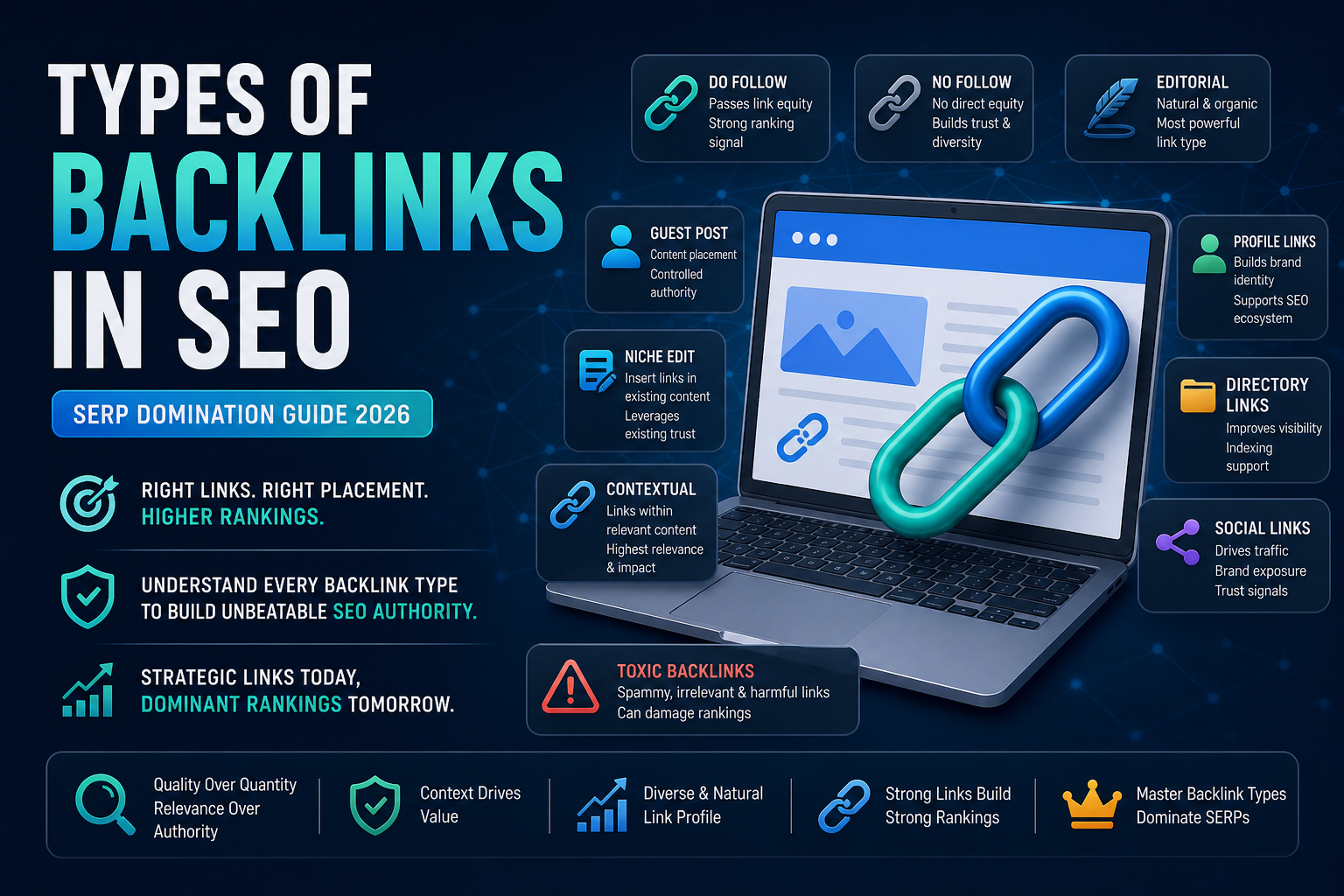
The primary backlink types in SEO include:
-
do follow backlinks;
-
no follow backlinks;
-
editorial backlinks;
-
guest post backlinks;
-
niche edit backlinks;
-
contextual backlinks;
-
profile backlinks;
-
directory backlinks;
-
social backlinks.
Frequently Asked Questions (FAQ)Which Backlink Type Carries the Most Weight?
Editorial and contextual backlinks generally carry the highest SEO value because of their natural placement, semantic relevance, and strong trust signals.
Do No Follow Links Still Have Value in SEO?
Yes. No follow backlinks help diversify backlink profiles, strengthen branding signals, and contribute indirectly to traffic and engagement patterns.
Can Certain Backlinks Harm Rankings?
Yes. Low-quality or toxic backlinks from spam networks, link farms, or irrelevant sources may negatively affect website trust and ranking performance.
Conclusion: Backlink Types Dictate SEO Success
In 2026, SEO success is no longer determined by how many backlinks a website acquires.
It is determined by:
-
backlink classification;
-
contextual relevance;
-
ecosystem consistency;
-
strategic link architecture.
Websites that understand backlink types can build authority profiles that remain:
-
scalable;
-
sustainable;
-
resilient against algorithm changes.
In modern SEO, link building is no longer simply about obtaining links.
It is about designing a trusted authority architecture within Google’s evolving ranking systems.