Reasons Most Individuals Fall Flat When Purchasing Backlinks in 2026
Backlink purchases no longer work as a shortcut to achieving high rankings. It is an SEO strategy that can build website authority or, conversely, ruin it in the long run.
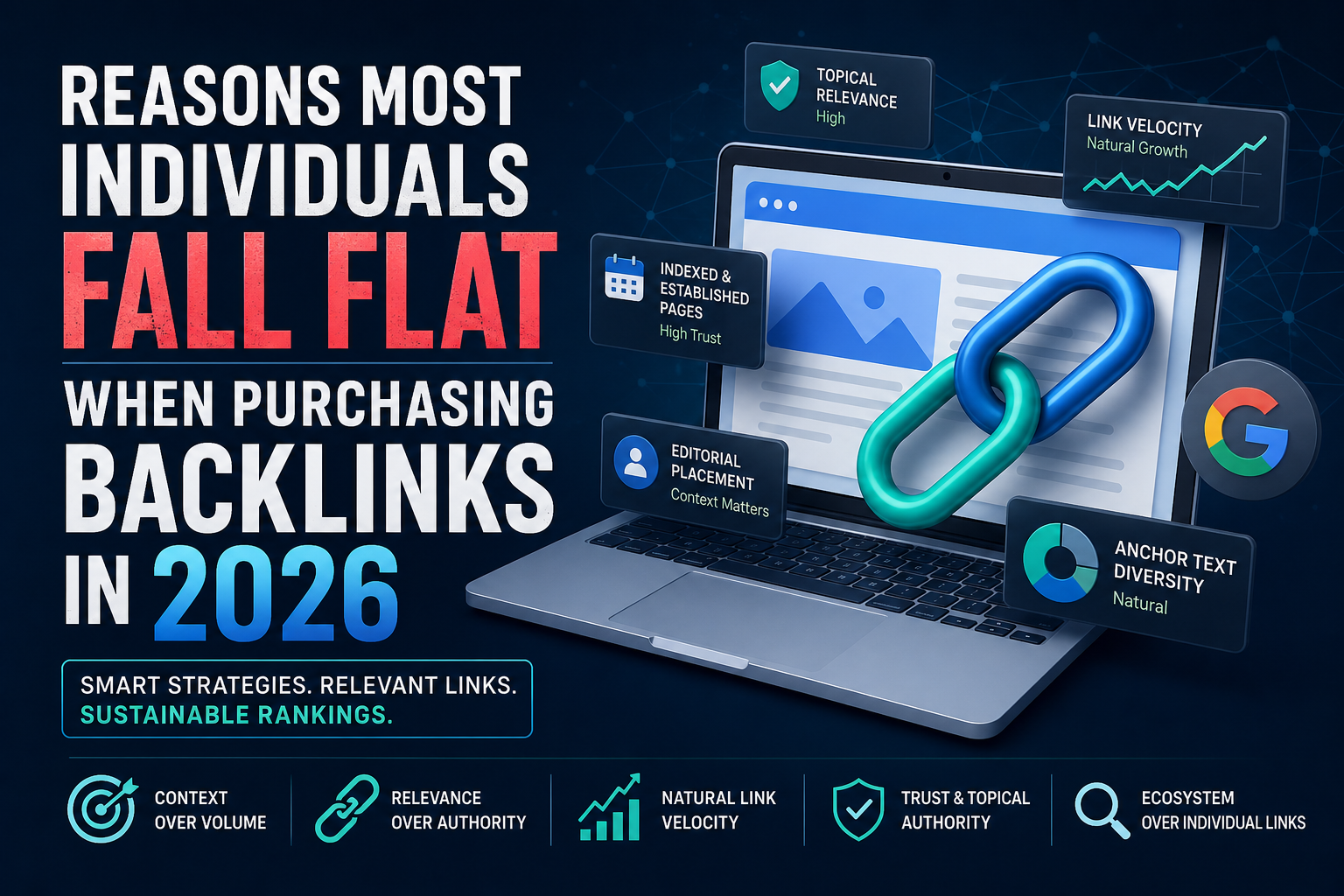
What most people fail at when purchasing backlinks is making sure all links have similar behavior. Actually, Google algorithms for ranking websites now interpret all links in terms of a relevant and contextual trust graph.
This implies that although it is possible for two websites to get the same number of backlinks, the website that will have the better ranking is the one that understands how to use backlinks effectively, rather than simply purchasing them.
The future of search engine optimization will change by the year 2026.
In 2026, buying more backlinks is no longer the solution for SEO success.
Understanding What “Buying Backlinks” Actually Means Today
“Buying backlinks” is a misnomer, as it makes people believe that this is a straightforward process. In contemporary SEO, it is more appropriate to view the process of buying links as:
Getting editorial placement inside pre-established authority ecosystems
Such ecosystems can be:
-
niche blogs that have topical authority;
-
editorials that have proven records of publication;
-
contextual webpages that have been indexed by Google before.
When you buy a backlink, what you do is not buy an increased rank directly. What you pay for is getting into pre-existing contextual trust environments indexed in Google.
It is very important to understand the difference since it is not only about the backlink itself, but also about the ecosystem where it exists.How Google Actually Evaluates Paid Backlinks (Important Ranking Layer)
The modern backlink evaluation system, which draws inspiration from the Helpful Content System and PageRank updates introduced by Google, involves several stages:
1. Contextual Relevance Assessment
First comes the assessment of the contextual relevance of the backlink. The backlink will be considered valuable only if its immediate context is semantically consistent with the content it is linking to.
2. Website Trust Evaluation
Then comes the issue of the reliability of the linking website. Google assesses whether the linking website is consistently publishing content in the chosen topical cluster or is acting more like a link farm.
3. Linking Neighborhood Analysis
Third comes the analysis of the linking neighbors. This stage implies that Google analyzes all outbound links that are located on the same page. If the page has too many links pointing to unrelated websites, the value of your backlink will suffer.
4. Backlink Acquisition Behavior
And finally, the last step implies an analysis of the behavior of backlinks during their acquisition process.
Strategy 1: Contextual Placement Inside Topical Authority Content
The most effective backlink technique for the year 2026 will not be guest posting or niche editing but contextual placement within high-intent environments.
A contextual backlink is not merely inserted into the environment, but rather naturally incorporated into an information flow. The importance of this lies in the fact that Google places greater emphasis on backlinks that are considered editorial endorsements as opposed to structural backlinks.
For instance, a backlink embedded in a discussion about SEO strategy has greater value for rankings than a backlink placed in:
-
author bio sections
-
sidebars
-
footers
Strategy 2: Relevance Now Overrides Authority Signals
SEO was traditionally focused on domain authority, such as DR (Domain Rating) or DA (Domain Authority). Though they are still good for directional analysis, they do not serve as the sole determiners of the ranking potential anymore.
Relevance Will Outweigh Authority Metrics in 2026
A mid-authority resource in your niche will be able to outrank the high-authority one that is not relevant due to how Google creates its rankings via topic clusters.
Google takes into account:
-
if the website is consistent in creating content in a particular niche;
-
its depth in addressing all the sub-topics associated with it;
-
how the outbound links on the website reinforce relevance.
Strategy 3: Guest Posting Must Be Indistinguishable From Editorial Content
Guest posting is still one of the best backlinking methods, provided it is done at editorial-quality standards.
The issue is that there are now too many low-quality guest posts. Websites are made solely for guest posting, and Google is aware of such trends by looking at:
-
quality inconsistency;
-
outsourcing links;
-
a lack of user engagement indicators.
A successful guest post should look like an editorial article. It must not seem SEO-optimized but rather intended for the reader, with the link being included organically within the post.
In such cases, the backlink will inherit all the contextually established trust from the host page.
Strategy 4: Niche Edits Leverage Existing Google Trust Signals
Niche edits or link inserts have become some of the most popular methods for SEO because they make use of established ranking signals rather than trying to create new ones.
When using a backlink on a page that is already indexed and ranking, you essentially add your website to a page that already has:
-
established crawl trust;
-
established search visibility;
-
established engagement signals.
This creates a multiplier effect because your link is placed on a page that already possesses authority.
But the key is relevance; anything else is meaningless.
Strategy 5: Link Velocity Must Mirror Organic Growth Behavior
Google doesn’t simply consider individual backlinks; rather, Google analyzes growth trends.
The pattern of growth for organic backlinks usually follows these stages:
-
Low start-up growth rate
-
Moderate mid-growth rate
-
Stable long-term growth rate
If a website suddenly receives a massive increase in backlinks without supporting signals such as content growth, brand mentions, or increased traffic, this may indicate unnatural behavior.
That’s why sustainable SEO depends more on proper distribution than pure volume.
Strategy 6: Anchor Text Must Reflect Human Behavior Patterns
Anchor text may be one of the strongest ranking signals, but it is also one of the easiest areas to over-optimize.
Modern algorithms detect when anchor text distributions fail to reflect natural linking behavior. Excessive use of exact-match keywords creates detectable patterns and diminishes credibility.
A Healthy Anchor Text Ecosystem Includes:
-
branded anchor text;
-
URL anchor text;
-
unrelated text such as “read more”;
-
partially matching contextual text.
These signals improve authenticity and increase long-term ranking stability.
Strategy 7: Backlink Value Is Ecological, Not Individual
One of the most advanced theories in SEO in 2026 suggests that backlinks should never be evaluated individually, but rather as part of ecosystems.
Google assesses:
-
internal linking patterns on a website;
-
topical congruence across pages;
-
behavioral patterns for outgoing links;
-
historical content stability.
Backlinks originating from a credible ecosystem carry greater weight because they inherit all the credibility signals surrounding them.
That is why the same backlink can generate vastly different ranking results depending on the ecosystem in which it exists.
Realistic SEO Pattern Observation
Controlled SEO tests from several niche websites reveal a common trend:
-
Sites prioritizing highly contextual backlinks appeared in SERPs between 6 and 10 weeks.
-
Sites prioritizing high-volume but less contextually driven backlinks experienced delayed or inconsistent ranking improvements.
This was not about backlink quantity.
It was about the density of contextually relevant backlinks.
Featured Snippet Block
What Would Be the Best Method to Buy Backlinks in 2026?
The best method to buy backlinks in 2026 would be by placing your links within highly relevant topical content while maintaining proper link velocity and contextual consistency.
Frequently Asked Questions (FAQ)
Does Purchasing Backlinks Have Any Merit in 2026?
Yes, but only when the backlinks purchased are contextually relevant to the website’s content and niche.
What Types of Backlinks Are More Valuable in SEO Today?
Niche-relevant, contextual backlinks from authoritative and legitimate websites perform best in modern search engine optimization.
Are Certain Backlinks More Useful Than Others?
Yes. Contextual backlinks placed naturally within editorial content tend to outperform structural links such as sidebar or footer placements.
When Do Paid Backlinks Start Affecting Rankings?
Generally, backlinks begin influencing rankings within 4–12 weeks, depending on indexing speed, domain authority, topical relevance, and competition level.
The Conclusion: The Actual Winning Formula of SEO
In 2026, backlink success is no longer measured by quantity but by relevance within Google’s evolving knowledge systems.
Successful websites share one common principle:
They do not simply buy backlinks; they build semantically relevant authority networks.
When backlinking follows relevance and contextual trust principles, rankings become far more sustainable and achievable over the long term.